What Manhattan Looked Like in the 1970s Through My Eyes, Part 2
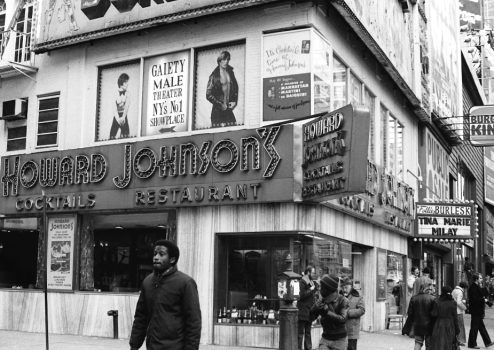
All photos copyright Betsy van Die and available in high resolution from original negatives. Permission needed to reproduce. By the time I was in my second year at RISD, I considered myself a veteran visitor of NYC. I was attracted to Times Square and all the sordid sights. I never would have dreamed of photographing the seedier side of Chicago’s strip clubs in the South Loop. Somehow I felt emboldened being away from home and photographing in NYC.  Times Square was a far cry from my ivory tower art school existence in Providence and even farther from my idyllic suburban Chicago upbringing. I found Times Square both fascinating and repulsive and completely different than anything I had ever seen. I was not a total rube, having spent a lot of time as a kid in the City of Chicago itself – but NYC was unique and I was smitten. I shot a lot of B & W photos in Times Square, and in retrospect, I was lucky that nobody bothered me. But I have so many regrets regarding photos I didn’t take back in the day, including 42nd Street and the interiors of diners and bars. Probably best that I didn’t venture into the latter, since I was an attractive young woman by myself. November 1977 Tiger Sign Company, Bowery and Delancey I couldn’t find out anything about this business, but still love the signage.   Pearl Paint and Canal Street Jeans Canal Street was one of my favorite hangouts thanks to Pearl Paint, all the cool job lot stores, Canal Jean Co., a dingy little antique mall, and street vendors selling vintage stuff. Pearl Paint’s NYC demise reflected the passage of time and loss of my youth. It was one more sign of gentrification that has nearly destroyed the…
Continue reading

What Manhattan Looked Like in the 1970s Through My Eyes, Part 1

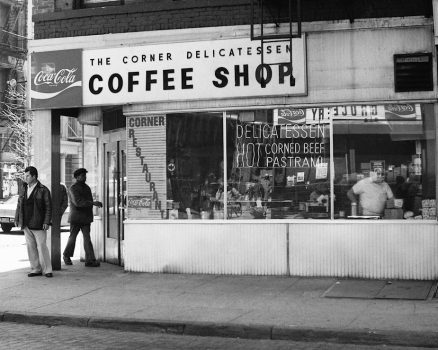
All photos copyright Betsy van Die and available in high resolution from original negatives. Permission needed to reproduce. You might wonder why a Chicago native who has lived in the Windy City nearly all her life is so fond of the Big Apple and has an Instagram page dedicated to NYC in the 1970s. The answer can be traced back to my youth and coming of age when I was an art student at RISD. I took the Amtrak train from Providence to Penn Station many times during my four years at RISD, staying with my older sister in one of her many NYC apartments either in the Village or SoHo. I think the other reason I am enamored of NYC is that my dad was born in Brownsville, Brooklyn and while you can take the boy out of Brooklyn… Indeed, he adored NYC and made yearly trips there for many decades that combined work with pleasure. From the time I was a toddler until he was too old to travel, he would attend winter meetings of either the American Psychiatric Association or American Psychoanalytic Association in the Big Apple. My mom would hang out with the other wives during the day and my parents would go to art galleries, museums, and plays during his leisure time. He shared so many personal stories about NYC with me, both about his family and growing up in Brownsville, as well as about Manhattan, Coney Island, and the Catskills. And of course, he was a talented amateur photographer who taught me how to develop and print photos in our basement darkroom when I was just 12. It’s hard to forget my first NYC visit because my sister and I got our signals crossed and I waited in the wrong area of Penn Station….

Continue reading

Vintage Providence – a Photographic Journey on Weybosset Street

I have many fond memories of exploring downtown Providence during my art school days at the Rhode Island School of Design. It was somewhat decayed and run down and I liked that aspect.  I already wrote about historic buildings and personal memories of past haunts on Westminster Street, in an earlier and more comprehensive blog. The oldest street traversing downtown Providence, Weybosset Street curves along its length, intersecting with Westminster at the northeast end. The origins of Weybosset date back to the Pequot Indian Trail, which originally traversed the southern edge of Weybosset Hill at its northeast end. A bluff existed on the narrow eastern end of Weybosset Neck at the current site of the Turks Head building. The name used by Indians for the crossing point in the Providence River between the east and west sides was Waubosset, which means “at the narrow passage.” In the 18th to 19th centuries, various parts of Weybosset (especially from Dorrance to Chestnut Street) were called Broad Street, however, by 1893, the entire length was known as Weybosset. Until 1964, Weybosset curved north to meet Westminster in front of the Cathedral of Saints Peter and Paul. The western portion of the street was closed to create the Weybosset Hill Redevelopment Project parcel. And in 1978, the Westminster Center Project transformed the street into a uniform width from Mathewson to Dorrance Street, while creating a park like area on the street’s north side.   The Arcade, 65 Weybosset   Built in 1828, the Arcade is the nation’s oldest indoor shopping mall featuring Greek Revival columns, granite walls, and classic facades. I found a few charming trade cards from Arcade businesses, pictured in the above gallery. The Arcade is a commanding presence on both Westminster and Weybosset Streets. It was designated a National Historic Landmark…

Continue reading

Connecting the Past to Present in NYC Photographs

Over the last two years, I have scanned black and white negatives and a few color slides I shot in NYC between late 1976 and 1980 when I was a student at the Rhode Island School of Design. My older sister lived in various apartments in SoHo and Greenwich Village and I visited every chance I got on school breaks. I enlarged and matted about 25 of these photos and took them with me when I moved to Rotterdam, the Netherlands in July 1980. I never printed any of the other photos, so scanning them provided an avenue of rediscovery of my own youth and a gritty NYC that no longer exists. This project summoned an array of emotions and memories about this “coming of age” period in my life and the inevitable passage of time.     In 1981, I showed these photos in Rotterdam and got some press, one of which was a little critical and missed the point of my photographs. The critic said that my photographs lacked the social commentary of Bruce Davidson’s work. Although I admire Davidson’s work, it was never my intention to emulate his socially conscious photography. A few select photographers informed my early photographic work – especially those who worked for the Farm Security Administration, such as Walker Evans, Russell Lee, Jack Delano, and the great photographer Berenice Abbott. Today, my photos have far more meaning than they did back then because they picture a NYC that no longer exists due to gentrification, over commercialization, and greed disguised as progress. NYC in the 1970s I was a little astonished that I ventured into areas that were considered dangerous back in the 1970s, as evidenced by many articles written on this dark and turbulent era in NYC history. Yes, the city was edgy and…

Continue reading

Downtown Providence – A Nostalgic Stroll Down Westminster Street

When I was an art student at the Rhode Island School of Design, I loved exploring downtown Providence and taking photographs. In celebration of the 40th anniversary of my RISD graduation on May 24, 1980, I’ll be posting a series of blogs looking back – featuring historic photos and postcards. The first blog is about Westminster Street and some of the wonderful landmark buildings that still exist. Also included are now-defunct businesses I encountered during my RISD years, as well as long-forgotten ones from the late-18th to early 20th centuries. I fondly remember walking on Westminster all the way past downtown to Olneyville to buy jewels at Wolf E. Myrow. During my RISD years, the portion of Westminster in downtown Providence was a pedestrian mall and closed off to vehicles. I loved the somewhat seedy quality of downtown Providence and would likely bemoan its gentrification if I returned. Department Stores Woolworth: Located at 185 Westminster in a five-story building from 1920, I would buy things at this five and dime now and then, but it didn’t have the charm of my favorite Chicago Woolworth store.     Thom McAn: I remember this retail chain on Westminster since it was near Woolworth, but I never went inside nor purchased shoes from this brand. Their retail stores closed in the late 1980s after being bought by K-Mart and subsequently Sears, who still sells this brand – that doesn’t bode well, although I think Walmart also sells them. Lerner Shops: Located in the former Wilkinson Building (mentioned separately later) at 210–216 Westminster, I never shopped here, nor at the location on State Street in Chicago. Founded in 1918 by Samuel A. Lerner and Harold M. Lane in NYC, New York & Company purchased the company in 2004 and they’re still in business.   …

Continue reading

10 Female Artists I Didn’t Learn About in Art School

I’ve been reading old Art in America issues and it hit me like a ton of bricks that I learned only about a handful of female artists at the Rhode Island School of Design (RISD). I do remember the visiting artist Jackie Winsor talking about Eva Hesse and Ana Mendieta. On the other hand, we were introduced to many female authors and several famous ones gave lectures. I met Elaine de Kooning, who was a guest lecturer during my art history class with Baruch Kirschenbaum freshman year. She showed us photos of the sketches for her commissioned JFK painting, among other pieces. It made sense that she was invited to RISD – apparently she was tight friends with Lee Hall, then president of RISD. Hall would betray her good friend four years after de Kooning’s 1989 death from lung cancer in her book, Elaine and Bill: Portrait of a Marriage / The Lives of Willem and Elaine de Kooning. By all accounts, this was a salacious, tell-all, shoddily researched book with mediocre writing that was butchered by critics. I think the reason we didn’t learn about more female artists was tied to the era in which I went to RISD, 1976 – 1980. Moreover, many female artists who later gained fame were virtually unknown when I was in art school. So in honor of Women’s History Month, here are 10 trailblazing female artists I’m glad I learned about – better late than never. This list barely scratches the surface, but it’s a start.   Grace Hartigan (1922 – 2008): I certainly was aware of Helen Frankenthaler and Joan Mitchell, but somehow didn’t know anything about Hartigan until recently. Interestingly, she was the first female Abstract Expressionist to gain fame in 1950, when art critic Clement Greenberg and art historian Meyer…

Continue reading

The RISD-Chicago Vintage Party Favor Connection

  My friend Barbara recently sent me a stack of old student newspapers from our days at the Rhode Island School of Design (RISD). Perusing these was an enjoyable trip down memory lane and I certainly plan on mining these for future RISD and Providence-related blogs. I uncovered a completely unrelated, unexpected, and delightful surprise in the October 28, 1977 Halloween issue. Lo and behold, one of the contributors included visually-intriguing catalog pages from Van Housen’s Favor Co., Inc. My assumption is that they found this in the RISD clipping room (now called the Picture Collection), a wonderful historical archive of all sorts of paper ephemera. Naturally, the cool-looking graphics beckoned to the sleuth in me and I had to do further investigating. Dennison Was Primary Competitor Van Housen’s was a Chicago-based company located at 81 W. Lake Street. Their primary competitor was Dennison Manufacturing Company which was founded in 1844 by Colonel Andrew Dennison. They opened their first store in Chicago in 1864, with subsequent store openings in the 1870s in Boston, New York, and Philadelphia. Although Dennison already had a longstanding reputation for manufacturing high-quality paper goods, it was crepe paper decorations that set them apart. If you recognize the Dennison name, it’s likely because the company merged with Avery International Corp. in October 1990.   I couldn’t find definitive dates when Van Housen’s was in business, but I did uncover ads from 1922, 1923, 1924, and the 1930s. I also uncovered an interesting article on crepe paper decorations that appeared in the Autumn 1924 issue of Fort Dearborn Magazine, with excerpts below: During the holiday season when entertaining is the order of the hour, many a social affair is given festive background by the use of appropriate crepe paper decorations, favors and novelties. While the demand for…

Continue reading

Art Supply and Camera Stores That Are No More

Favor Ruhl 425 S Wabash 1910 and 1938

I wasn’t born with a silver spoon in my mouth, I was born with a crayon in my hand. By the time I was 5-years-old, I was drawing all sorts of things on cheap yellow paper my dad bought by the ream. The crayon was replaced with ballpoint pen, magic markers, colored pencils, pastels, paint brushes, sculpting tools, and by age 12, darkroom equipment. Going to art supply and camera stores as a kid was nearly as glorious as walking up the street to the corner store to buy my favorite candy. That’s right, for many artists and/or photographers, a visit to an art supply or camera shop is like unleashing an overzealous kid in a candy store! Nowadays, it’s hard to find old school art supply and camera stores – many have closed. In Chicagoland, you can buy art supplies at Dick Blick, Hobby Lobby, Michaels, JOANN Fabric and Craft, and a handful of small shops. Of course, you can always buy art supplies online, but it’s not the same experience. I first encountered Utrecht in NYC and later shopped at the store on South Michigan Avenue. Utrecht is now partnering with Dick Blick, although they are still doing business online independently. My favorite Chicago-area store is Artist & Craftsman Supply, an employee-owned shop in the old school model – while there are stores across the U.S., the Chicago location at 828 S Wabash reminds me of defunct stores of my youth. Good’s of Evanston is an independent store that has been in business for more than 100 years. It’s more renowned for its framing services and has a certain slick look these days that is the antithesis of old school. Thank heavens for Central Camera, a truly iconic old school store in the South Loop that has been…

Continue reading

Seeking Francesca Woodman – Retracing the Past

It Must be Time for Lunch Now, 1979

“The work she produced in her short life is 100 times better than anything you have created or could ever create!” Those were the cruel, harsh words that were hurled at me from my 20-year-old daughter’s insolent lips in 2007. The occasion was a visit to the Tate Modern in London and the discovery of an Artist’s Room dedicated to Francesca Woodman. It was hard to process everything I was feeling when I saw those photographs. Difficult because my daughter’s post-teenage angst overshadowed what became a trip from hell, but also because I had somehow forgotten about Francesca in the context of my four years at RISD. I am not sure why it has taken me so long to write about this – perhaps I needed the distance and perspective of the passage of time. Or the sheer volume of online content could have dissuaded me – 567,000 Google hits on Francesca as of April 2015, and counting.

Continue reading

Reflections on a New York City Christmas

WashingtonSquare Park - Christmas 2012

    I have been experiencing a wave of nostalgia – it comes with age and recent losses of dear friends and our beloved little kitty Pepper. For me, the holidays seem to inspire reflections on the past – thinking back to how much New York City used to mean to me at Christmas. I have been digging up wonderful Christmas-related NYC photos from the Library of Congress and decided to delve into my own archives to see what I could find. When I was a child and up through about 2004, my parents would visit NYC every December for an annual psychiatric meeting at the Waldorf Astoria. While my dad was attending lectures, my mom would go window shopping with some of her friends. As children, my sisters and I always looked forward to my parents coming home with intriguing presents. My dad would also visit Russ & Daughters and purchase obscene amounts of candy that he had shipped home. Chocolate covered coffee beans, pastel chocolate mint lentils, and chocolate covered raspberry rings are the candies that I remember most. He would tell me stories about buying pretzels and roasted chestnuts from street vendors, shopping at B. Altman, Gimbels, and other now defunct stores; telling me tales that made it sound so magical.

Continue reading